Enterprises across the US have spent the past two years experimenting with AI assistants.
While many of the pilot programs demonstrate the potential of AI assistants, only a small number of these programs are being used in day-to-day business operations. The primary reason for this is typically not due to the performance of the AI model. Rather, it is because the AI assistant cannot access the systems from which the real answers come namely, the ERP system used by the enterprise to track orders, the CRM system that contains customer account information, and/or the internally developed operations portal that the operations department at the enterprise has relied upon for the last 15 years. At rSTAR Technologies, we believe the next step in enterprise AI is not simply developing yet another chatbot. We believe the next step is establishing a safe and controlled means to provide access to the business systems the enterprise already possesses for the AI-based tools that the enterprise's employees are currently utilizing.
The real bottleneck: great systems, disconnected AI
Most US enterprises run on a mix of platforms that were never built with AI in mind:
- Custom ERP and CRM applications
- Legacy databases and internally developed portals
- Business logic written in PHP, Java, or .NET
- Existing APIs and internal knowledge repositories
- On-premises applications that sit behind the firewall
These systems hold exactly the information employees want to ask an AI about. Questions like “What's the status of my order?”, “Do we have this product in stock?”, or “Show me the account details I'm authorized to see.”
Without a governed integration strategy, teams tend to fall back on one of two shortcuts. They build a one-off connector for each AI platform, or they grant the AI direct database access. The first creates a maintenance headache. The second is the kind of decision that keeps a CISO up at night.
What's needed is a controlled way for approved AI tools to use existing business capabilities safely.
Inside a recent engagement: modernizing access, not rebuilding systems
rSTAR recently partnered with a large enterprise client (unnamed for confidentiality) to build a custom, enterprise-grade MCP server on top of its existing applications.
Where they started. The client already had basic chatbots for order and inventory questions. But those bots mostly pointed users to a contact or opened a service ticket. The data behind the answer lived in older PHP applications and MariaDB databases, and a full rebuild wasn't on the table.
What they needed to solve.
- How can AI assistants pull real-time information from internal applications?
- How do we keep existing user authentication and authorization intact?
- How do we connect legacy systems without giving an AI model unrestricted database access?
- How do we build something that supports future AI tools and use cases?
What rSTAR built. We extended the client's application environment with MCP capabilities and security controls, then stood up a sandbox in rSTAR's environment so the client could validate it before deploying in-house. The architecture covers five areas:
- AI client connectivity: An approved enterprise AI client, such as ChatGPT Enterprise, connects to the MCP server.
- Identity and authorization: Users authenticate through the client's own identity provider and existing permission model.
- Governed business tools: Only specific, approved operations are exposed, never open-ended database access.
- Existing business logic: The client's current business functions and application-level authorization are reused, not rewritten.
- Validation and logging: Inputs and outputs are validated, and identity, invocation, and outcome details are recorded.
The first phase focused on one business application, with the architecture designed to extend to more as the program matures. Target capabilities include customer account lookup, order status, product availability, and service information.
How MCP works as a secure bridge
The Model Context Protocol is an open standard that lets AI applications discover and use tools in a consistent way. In rSTAR's approach, MCP acts as a governed access layer: the AI never queries your database directly. It can only call specific operations with defined inputs, outputs, and access rules.
Here's what happens when an employee asks, “What's the status of my order?”
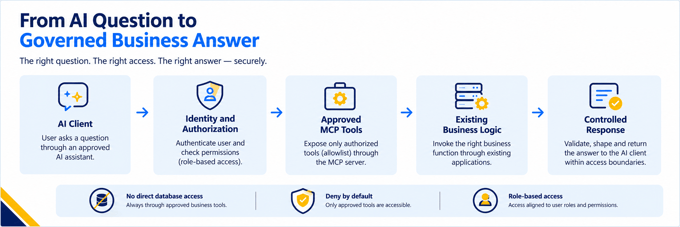
Figure 1. Every AI request passes through identity, authorization, approved tools, and your existing business logic before an answer is returned.
At every step, your existing application remains the final authority on business rules and who can see what.
Why your existing business logic should stay in charge
Your applications already encode years of hard-won rules: who can access which customer records, how data is validated, which workflows need approval, and what operational restrictions apply.
Rebuilding those rules inside a new AI layer creates duplicate logic, drift over time, and audit gaps. When your auditors or compliance team ask “who could see what, and why?”, you want one answer, not two.
That's why rSTAR's approach reuses your existing business functions. The MCP layer is not a replacement for your application's authorization, and it never provides unrestricted database access. It simply connects AI to approved operations while the controls you already trust stay in place.
Build once, use across AI platforms
Few enterprises will standardize on a single AI vendor for the long haul. Your organization may already be evaluating or using several: ChatGPT Enterprise, Gemini Enterprise, internal copilots, workflow agents, and eventually customer-facing assistants.
A reusable integration layer keeps your business capabilities at the center, so the AI client becomes just the interface. An approved order-status tool, for example, could serve multiple AI experiences, subject to each client's integration and authorization requirements.
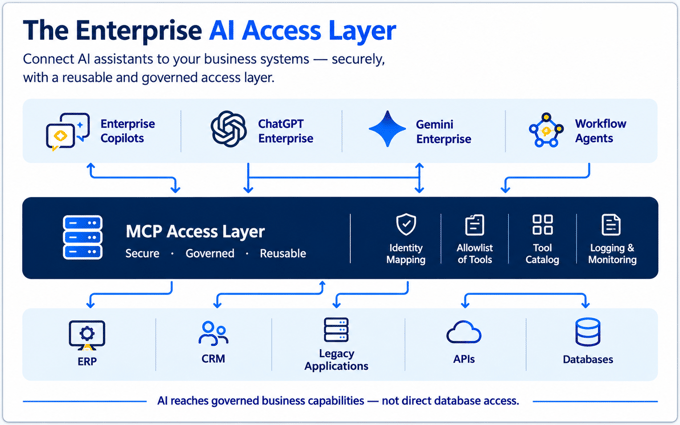
Figure 2. One MCP access layer serves many AI clients and connects them to ERP, CRM, legacy applications, APIs, and databases through governed tools.
The payoff:
- Less duplicated integration work across AI projects
- More consistent governance and tool definitions
- Tighter alignment with your existing applications
- A foundation for expanding into new business domains
- Less exposure to vendor lock-in as the AI market shifts
To be clear, no platform connects automatically. Each integration still needs technical compatibility checks, security review, authorization design, and testing. But reuse is built into the architecture from day one.
Where this creates value across US industries
The challenge above isn't unique to one company. Across American manufacturing, utilities, distribution, healthcare, and financial services, critical data sits in systems AI can't yet reach safely. The scenarios below are illustrative examples of how this approach could apply, not claims of completed rSTAR deployments.
|
Industry
|
Example employee question
|
Potential tools
|
Key considerations
|
|
Manufacturing
|
“Show me the latest maintenance history for this machine.”
|
Spec lookup, work-order status, maintenance history, quality findings
|
Plant-floor and ERP permissions; OT/IT boundaries
|
|
Energy & utilities
|
“What's the status of this customer's service order?”
|
Account info, billing exceptions, outage info, service orders
|
State PUC requirements; NERC CIP where grid systems are involved
|
|
Distribution & logistics
|
“Is this product available at the Dallas warehouse?”
|
Order tracking, warehouse status, availability, delivery exceptions
|
Customer-specific pricing and account visibility
|
|
Healthcare
|
“What's our current internal policy for this process?”
|
Policy search, operational knowledge, scheduling, admin info
|
HIPAA; a pilot does not by itself authorize access to PHI
|
|
Financial services
|
“What's the procedure for this service request?”
|
Policy search, servicing info, exception lookup
|
GLBA, SOX, and examiner expectations for audit trails
|
In every case, the value isn't conversational AI for its own sake. It's giving employees one place to get authorized answers instead of clicking through five different systems. The actual scope always depends on each organization's systems, permissions, and regulatory obligations.
A practical path from pilot to enterprise platform
Success isn't whether a chatbot can answer a question. It's whether the integration is secure, maintainable, auditable, and ready to grow. rSTAR follows a four-stage model so you can validate before you scale your investment.
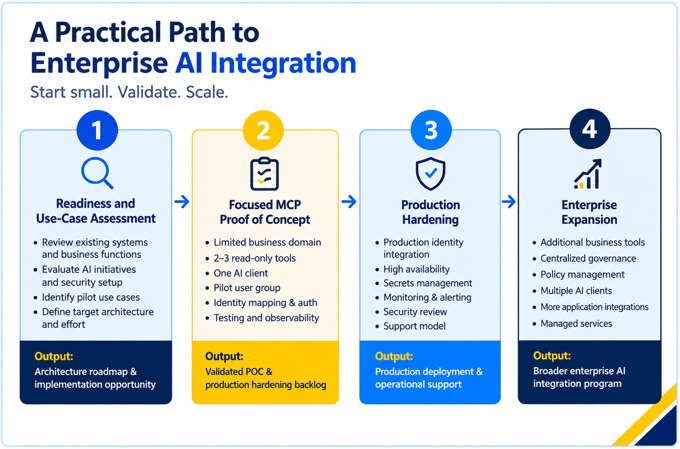
Figure 3. Start with an assessment, prove value with a focused read-only POC, then harden and expand.
Why start read-only?
A focused, read-only pilot lets you prove the fundamentals with minimal risk:
- The AI client connects cleanly to the integration layer
- Identity and permissions behave as intended
- The right business functions get called
- Returned data is properly scoped to the user
- Activity is logged and monitorable
- The use case delivers real value to employees
A successful read-only pilot doesn't mean every future workflow is production-ready. Hardening, additional testing, and security validation still matter before you expand into write actions. The principle is simple: start with a defined business need, validate the controls, and expand based on what you learn.
The future of enterprise AI is connected
AI assistants make information easier to reach, but their business value depends on what they can actually connect to. For organizations running custom applications and legacy platforms, secure connectivity is the step that turns a promising pilot into a real operational tool.
rSTAR's MCP-based approach rests on five principles: reuse your existing investments, preserve identity and authorization, govern business capabilities through a controlled tool catalogue, support multiple AI experiences, and build toward production responsibly.
The journey can start with a single, practical use case like order status, policy search, product availability, or service information. The goal isn't to replace the systems that run your business. It's to connect them to AI in a way that's secure, governed, and built to scale.
Ready to connect AI to the systems that run your business?
If your team is piloting AI assistants but struggling to connect them to ERP, CRM, or legacy applications, let's talk. rSTAR Technologies can help you assess use cases, evaluate MCP integration patterns, and pinpoint a low-risk starting point.
Schedule a conversation with rSTAR Technologies →